There are also questions we often hesitate to ask. How comfortable are we discussing religious beliefs or examining political ideas without allowing personal affiliations to influence our judgement? Do we pause to understand the meaning and cultural context behind an artwork? How much do we know about the knowledge systems that indigenous communities have preserved over generations? Even the language we use every day carries assumptions and meanings that we rarely stop to examine.
These conversations may not always be easy, but education should create spaces where such questions can be explored with curiosity, sensitivity, respect and an open mind.
This is precisely what Theory of Knowledge (TOK), a core component of the International Baccalaureate Diploma Programme (IBDP), seeks to encourage. It provides students with opportunities to explore how knowledge is constructed, interpreted, communicated and challenged. It teaches them that questioning an idea does not necessarily mean rejecting it, and understanding a different perspective does not mean abandoning one’s own beliefs.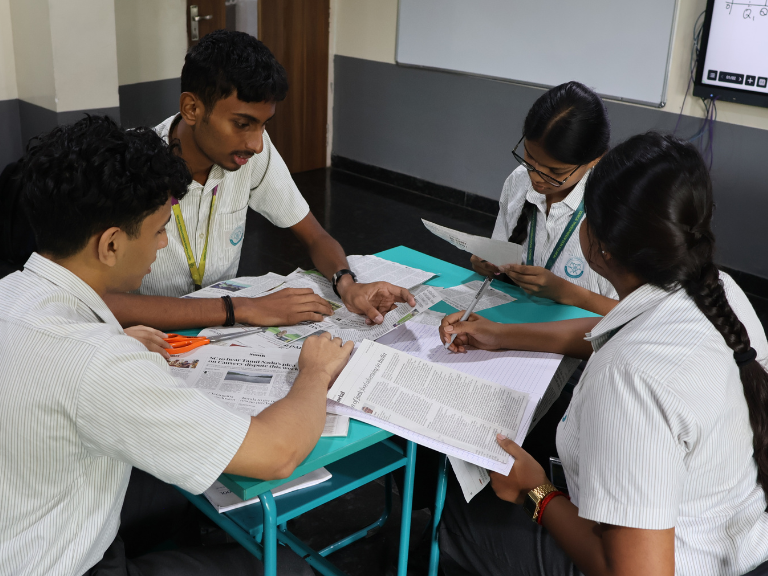
What exactly is Theory of Knowledge?
Theory of Knowledge is not simply another subject where students memorise facts or prepare for a conventional examination. It encourages them to step back from what they learn and examine how knowledge itself is acquired, developed and shared.
In simple terms, TOK encourages students to think about how they know what they know. It invites them to question the reliability of information, examine the assumptions behind their beliefs and understand how different perspectives influence the way we interpret the world.
Students explore questions such as:
- Science: How certain can we be that scientific knowledge represents the truth?
- Politics: How do our political beliefs and perspectives influence the way we interpret information?
- Arts: Does the meaning of an artwork depend on the artist’s intention or the audience’s interpretation?
There may not always be one definitive answer to these questions. What matters is the process of thinking, examining evidence and considering different possibilities. TOK shifts the focus from simply knowing something to understanding how and why we know it.
Connecting classroom learning with the real world
One of the most interesting aspects of TOK is that it does not exist in isolation from the other subjects students study. Instead, it creates meaningful connections across disciplines and encourages students to recognise that knowledge is developed in different ways.
When studying Natural Sciences, students explore how knowledge develops through observation, experimentation and evidence. They may question whether scientific knowledge is ever completely certain or whether it changes as new evidence emerges.
In History, they investigate how knowledge is constructed using historical records, sources and interpretations. They begin to understand that different historians examining the same event may arrive at different conclusions depending on the evidence and perspectives they bring.
Similarly, in the Arts, students explore how culture, emotions and personal experiences influence artistic expression and interpretation. They may examine how language shapes the way we communicate and understand ideas, or how indigenous communities develop and preserve knowledge through generations of observation and interaction with their environment.
Through these connections, students appreciate that different disciplines have different ways of producing, validating and communicating knowledge. They begin to understand that the process of arriving at an answer can be just as important as the answer itself.
Learning to question in an age of information and artificial intelligence
Imagine your child comes across a news report on social media, watches a viral video or receives an answer generated by an artificial intelligence tool. How would they decide whether the information is accurate, reliable or misleading?
These are the kinds of situations that make TOK particularly relevant today. Students are encouraged to examine the credibility of information, identify assumptions, recognise bias and consider whether the evidence presented is sufficient to support a conclusion. They learn to distinguish between facts, opinions and interpretations.
They also explore how technology influences the way knowledge is created, accessed and shared, along with the ethical responsibilities involved.
In an age when artificial intelligence can generate convincing responses within seconds, students need more than the ability to find answers. They need the judgement to evaluate those answers, recognise their limitations and use information responsibly.
The real advantage lies not simply in knowing how to access information, but in knowing how to question, interpret and use it responsibly.
From thinking to doing: How is TOK experienced by students?
TOK is not limited to classroom discussions. Students demonstrate their understanding through two important assessment components.
1. The TOK Exhibition
The exhibition invites students to explore how TOK manifests itself in the world around them. Students select one of the prescribed IA prompts and connect it with three real-world objects.
For instance, a student might choose a newspaper article, a family photograph and a scientific instrument to explore questions about knowledge, evidence or perspective.
The purpose is to help students recognise that knowledge is not an abstract idea confined to textbooks. It is present in everyday experiences, objects, decisions and interactions.
2. The TOK Essay
The TOK essay requires students to engage with a prescribed title and develop a reasoned argument using two Areas of Knowledge. They examine different perspectives, support their arguments with relevant examples, consider counterclaims and arrive at balanced conclusions.
Both components encourage students to move beyond simply stating what they think. They learn to explain their reasoning, explore different perspectives, support their arguments with appropriate evidence and examine the implications.
The skills your child develops through TOK
Although TOK is a distinct subject within the IB Diploma Programme, the skills students develop extend far beyond the classroom. They are relevant to higher education, professional environments and everyday decision-making.
Some of the most significant include:
- Critical thinking: Examining claims, questioning assumptions and evaluating evidence.
- Perspective-taking: Understanding different viewpoints and recognising cultural influences.
- Communication: Expressing ideas clearly and engaging respectfully in discussions.
- Research and information literacy: Identifying reliable sources and recognising misinformation.
- Reflection: Becoming aware of personal assumptions and the limitations of one’s own knowledge.
- Ethical reasoning: Considering the responsibilities involved in acquiring, producing and sharing knowledge.
These capabilities develop through discussions, research, reflection and opportunities to engage with unfamiliar ideas. Over time, students become more independent in their thinking and more conscious of how they arrive at their conclusions.
Beyond academic achievement: Developing thoughtful individuals
What kind of world will our children enter when they complete their education? Careers will evolve, technologies will transform industries, and many of the challenges they encounter will require solutions that draw upon multiple disciplines and perspectives.
There may not always be one correct answer to the problems they face. What will matter is their ability to ask meaningful questions, examine evidence, consider alternatives and make informed decisions.
TOK contributes to developing this intellectual independence. It encourages students to become curious rather than complacent, thoughtful rather than impulsive, and open to revising their understanding when presented with new evidence.
As educators, one of the most rewarding experiences is to see students move from asking, “Is this the right answer?” to asking, “How do we know this is right?” That shift represents an important step in their intellectual development.
At HIS Omega, we see TOK as an opportunity to nurture curious minds and encourage meaningful engagement with the world. It provides students with the space to connect classroom learning with real-life experiences, challenge their assumptions and appreciate the diversity of human knowledge.
Ultimately, the purpose of education is not merely to prepare children to answer the questions of today, but to equip them to engage thoughtfully with the questions of tomorrow.
Because in a world full of answers, the ability to ask meaningful questions may be one of the most valuable things we can teach our children.